
Leatherback Turtle
" target="_blank">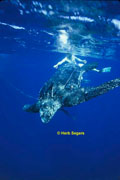 |
North Carolina is known as the “Graveyard of the Atlantic” because of its many shipwrecks. Years ago, I added another nickname, “Gateway to the Caribbean”, because of the great number of tropicals seen swimming side by side with northeastern species. Today, I’ll add a third moniker, “Home of the Unexpected”, because of the unexpected marine encounters that seem to happen on a regular basis. In the waters off the Tarheel State, I have been surrounded by three foot long amberjacks, taken on a tour of a shipwreck by a loggerhead turtle, watched sand tiger sharks remain steadfast in a three knot current (while I held onto the wreck for dear life), bitten by an oyster toadfish and amazed by the speed and maneuverability of Atlantic spotted dolphins. Without a doubt, my best encounter happened when a day of wreck diving turned into a rescue mission. “It’s only a scruffy old turtle,” quipped Captain Roger Huffman with very little enthusiasm. I was scrambling for my underwater camera when the captain jolted me back to reality with his observation, “the turtle is moving against the current and a snorkeler can’t keep pace.” Little did I realize that this was the beginning of an encounter between five members of New Jersey’s Metuchen Underwater Dive Club and the world’s largest turtle, the leatherback, Dermochelys coriacea.
|
|||
 |
 |
 |
 |
|
Click on the thumbnail to see a full sized photo |
||||
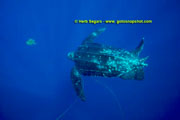
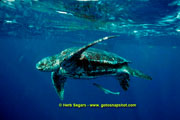
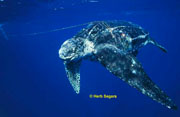
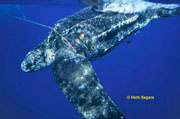
Fifteen miles out to sea, Captain Huffman, a commercial fisherman during the winter months, spotted a longline fisherman’s float that was free of the longline and moving against the current. Longline fishermen lay out miles of buoyed line with periodic baited drop lines. Their quarry is game fish like tuna, marlin or wahoo. These were the feasts that Captain Huffman conjured up as he moved closer to the float. Upon closer observation, his disappointment became our excitement. The specimen at the end of the forty foot tether was a six foot long female leatherback turtle that weighed in excess of eight hundred pounds. Knowing that I could not photograph this prize below water, I asked the captain to keep the boat close enough for topside photographs. A nod of the his head sent me scrambling below decks for a camera with polarized lens. Unfortunately, the turtle sounded before I could assemble my gear. Captain Huffman moved the boat slowly on the surface looking for another appearance. The seas were choppy and if the turtle surfaced more than thirty yards from the boat, it would be difficult to spot. I hoped that the drag of the longliner’s float would keep the leatherback from traveling too far. I didn’t have to wait long. The turtle surfaced close to the boat; so close that the buoy line became entangled in the ship’s propeller. We all felt terrible for inadvertently trapping this magnificent animal. Our moods changed when we realized that this was an opportunity for humans to correct an injustice imposed by other humans. We quickly made a plan to enter the water, observe how badly the turtle was trapped in the monofilament and cut it free. We would worry about the entanglement on the propeller afterwards. The cutting work was left to our best free diver, Ron Schaefer, who was assisted by his dive buddy, Don Ballinger. Joe Pakan remained aboard ship with the captain to provide any surface support required. Bill Rokicki and Marty Evensen would provide additional support in the water if required. I would record the event on film. The turtle was attached to the surface buoy by two monofilament lines that met at a wire leader which was wrapped around the turtle’s neck. A hook at the end of the leader was caught on the turtle’s shell. Fortunately, while Ron sized up the situation, the turtle’s movements untangled the leader from around its head. This was the time for Ron to cut her free. The task was definitely easier said than done. Ron was intimidated by the size of the turtle and with the power that it exhibited in the water. Later, I found out that a fin slap from a leatherback can inflict serious harm to a person. Perhaps it was best that we were uninformed participants of this freedom swim. Ron took his time finding the right moment to make the cut. As he worked his way along the monofilament towards the turtle, Don made sure that Ron did not become entangled in the line. A quick cut very close to the leatherback’s shell freed it from its floating encumbrance. Ron described the leatherback’s action immediately after release, “he took a few strokes with his front flippers and stopped, seeming to wait for the tug from the buoy or the boat. When neither came, he swam a few more strokes and waited again. Still no tug. Knowing that he was free, he calmly swam off into the depths.”
|
||||
 |
 |
 |
 |
|
Click on the thumbnail to see a full sized photo |
||||
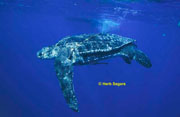
Leatherbacks are the largest living turtle, reaching a length of seven feet and a weight between 600 and 1,600 pounds. They are the only surviving member of the family Dermochelyidae. They roam the tropical waters of the Atlantic and Pacific oceans as well as colder waters as far north as Newfoundland and British Columbia in search of their favorite food, jellyfish. Leatherbacks are ideally shaped for oceanic life with broad shoulders and powerful front flippers that span six and a half to eight feet across. The turtle’s carapace (shell) is strongly tapered with seven longitudinal ridges to increase water flow over the animal’s body, reducing the energy required to move through the water. The leatherback’s framework is different than other sea turtles. Its shell is not rigid but is a leathery skin embedded with many small, bony platelets. It is supported by a lattice-work of small bones in a tough, oil-saturated connective tissue. The leatherback’s ribs lie beneath the carapace and are not fused together. Its belly plate consists of eight bones joined in a broad ring and covered with thick tissue. The end result is a streamlined, flexible body, well-suited for long distance endurance swimming. The turtle’s flexibility may be important in withstanding the great pressures incurred during deep diving excursions that have been recorded in excess of 3000 feet. I needed to know more about leatherback turtles so my wife, Veronica, and I visited our good friends, Bob Schoelkopf and Sheila Dean at the Marine Mammal Stranding Center in Brigantine, New Jersey. The center’s main function is to rescue and rehabilitate stranded or stressed marine mammals and sea turtles. They have responded to over 1,000 strandings of whales, dolphins, seals and sea turtles since their beginnings in 1978. They now exist as a private, non-profit organization funded through donations, memberships, sales of shirts and fund raising efforts. In 1993, the Marine Mammal Stranding Center recovered a dozen dead leatherback turtles. Most died from propeller cuts and entanglements in nets and lines. Bob expressed his dismay, “the volume of leatherback turtle deaths is frightening. The saddest thing that we see here is the amount of man-induced injuries. These animals would be in great shape if it wasn’t for us. We have caused more harm to wildlife than wildlife has caused to itself.” The leatherback encounter propelled me into an increased awareness of this awesome world traveler. I learned that one leatherback turtle traveled 3700 miles from Surinam on the northern coast of South America to Ghana, West Africa in less than a year; that leatherbacks place emphasis on underwater terrain when choosing nesting sites to avoid reefs and rocks that can injure them when landing, that their mouths and esophagus are lined with long backward projecting spines that help them to eat jellyfish; and that a layman can distinguish between a male and female leatherback turtle by the length of the turtle’s tail. The female’s tail is short while the male’s tail extends past the rear flippers. Was this leatherback the victim of uncaring longliners who brought the turtle to their boat, realized how large it was and cut the main line free, leaving the turtle burdened with its tethered float or had the leatherback used its brute strength to break free of the main longline? Only the longliners or the leatherback know for sure. Leatherback turtles are critically endangered. Thanks to Don Ballinger, Marty Evensen, Captain Roger Huffman, Joe Pakan, Bill Rokicki, Ron Schaefer and Herb Segars, one elder statesman of the leatherback family lives to tell her grandchildren that not all humans are bad. You can see more leatherback turtles in leatherback turtle section of my stock photo gallery.
|
||||
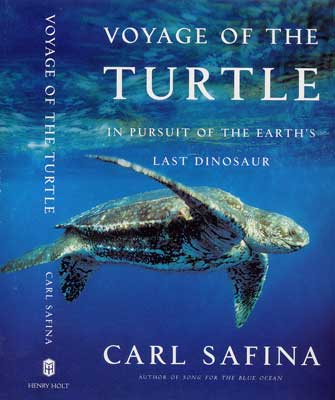
If you would like to read more about leatherback turtles, there is a book out by Carl Safina, entitled "Voyage of the Turtle: In Pursuit of the Earth's Last Dinosaur" that has my photo on the cover. Click on the cover image or here to go where you can purchase the book. |
|
|||

|